
The Crab Museum: Activism with a Pinchline

‘A man walks into a restaurant with a crab under his arm and says “do you make crab cakes?”. The manager answers “yes, we do.” “Good,” says the man “because it’s his birthday.”
Hosted by the Crab Museum in Margate, United Kingdom, a panel consisting of comedians and a classroom of Primary School students voted this joke to be the ‘Crab Joke of the Year’ in 2024. One might read this as a whimsical marketing strategy for the museum and while this wouldn’t be entirely wrong, the Crab Joke of the Year hints at the core of the museums’ approach and philosophy of running a museum. Through humour and activism, Crab Museum asks: What is actually the role and responsibility of museums?
As Rosa Dyer points out at various points in her excellent podcast series on museums, collecting and displaying objects, whether organic or inorganic, is far from a neutral practice. Conventionally, natural history museums display animals that, at one point in history, were killed, taxidermized, and mounted. Which animals they choose, where they end up, and how museums display them is fraught with the colonial urge to collect and consume, effectively turning animal lives into spectacle and imbuing them with all kinds of meanings and interpretations. One need only to visit the Natural History Museum in London to see predators frozen in menacing poses, different species of birds who would never meet perching on the same branch, and insects statically propped up against a white background using bits of metal. All of this instils animal corpses with explicit and implicit ideas about human domination, colonialism, and essentialization of what these animals are. As Rosa points out, museums transform animals into impassioned objects.
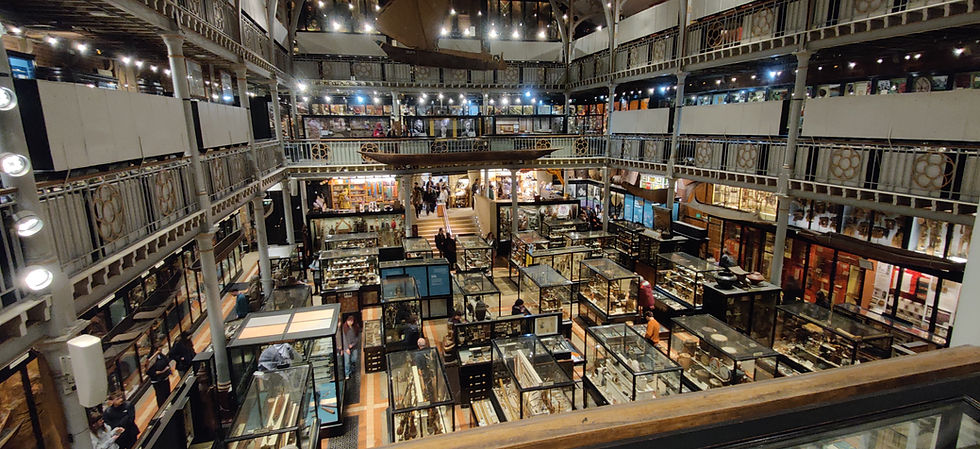
Conventionally, museums claim that their societal value lies in preservation of artefacts and education of current and future generations. Preservation is not as easy as it might seem. Museums must take a myriad of precautions to protect objects from dust, bugs, and the climate. Education, on the other hand, happens predominantly through static signs besides displays that have an air of objectivity and often dryly inform the reader of what the object is. While museums, nowadays, try to subvert this dry dissemination by creating audio tours, inviting visitors to challenge their beliefs, or by explicitly stating the problematic nature of their collection, the majority still mainly use plaques full of words to offload supposedly objective knowledge onto the reader.
But the crab museum is different…
Scuttling through the crab museum
Initiated by three British scientists, the Crab Museum subverts the whole idea of what a museum can be. When I visited the museum it took me forever to reach the main museum space on the first floor. Not because the hallway leading up to a flight of stairs was difficult to navigate, but because I got sidetracked by the walls filled with a crab-timeline featuring humorous millennial-coded doodles and jokes that grabbed my attention. The museum itself consists of two spaces and a shop, each boldly questioning the status quo of museums albeit in different ways.
The first room resembles a museum as you might expect it: Wall-mounted plaques explaining how crabs evolve, what ecologies they inhabit, and describing the life of an average crab. Interspersed by comedic doodles that accentuate the knowledge dump, the Crab Museum does not stray too far from the beaten path here. However, visitors soon find themselves reading a fantastical and less-than-factual historical story featuring a 2,5 meter-long crab. It is told through newspaper clippings, a video of an interview with (the granddaughter of) a Bearded Lady, and plaques of text, only for the multi-plaque story to end with a small note saying “Guess what? Not everything you read in museums is true!”
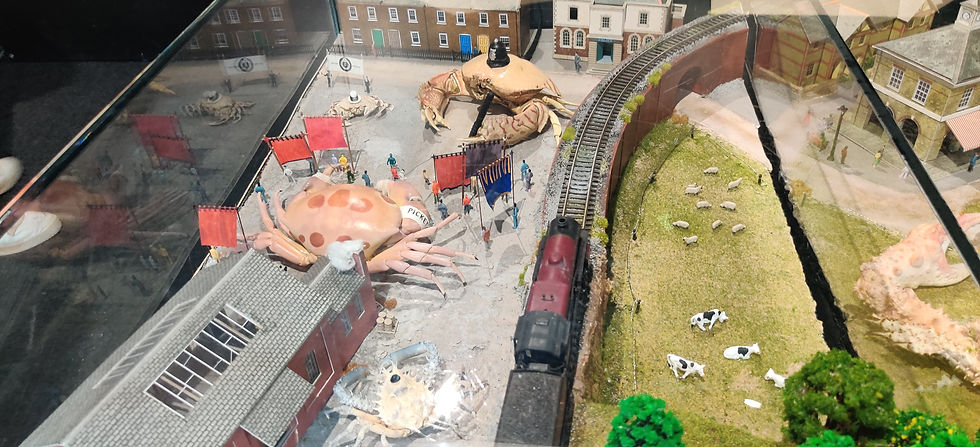
The same critical energy continues in the centrepiece of the first room. A glass-covered diorama of a town called Crabton-on-Tyne, inhabited by clothed crabs, is contextualised by a sign in the style of the Tourist Board: “The crabs in this diorama all live in different parts of the world, so would never be seen together in real life. Because of this, it would be misleading to depict them in a realistic natural setting. So, we have built them into a diorama of a typical English town during the 1926 General Strike’.
Curators or activists?
Whereas critique in the first room is more implicit in the form of side-notes, outlandish dioramas, and hints at the museum’s political stances, the second room drops all pretenses and becomes overtly political. Under-prepared visitors might be surprised to read plaques about climate change, the commodification of nature, and colonialism, but a sign titled “but what does this have to do with crabs?” quickly resolves any confusion. Through the sign, the museum zooms out from crabs to the ecosystems they inhabit to the world at large. It ends with “you might not think politics has anything to do with you, but right now learning about science and caring about animals have become political acts. So saddle up, Twilight Sparkle! We have a system to smash!”.
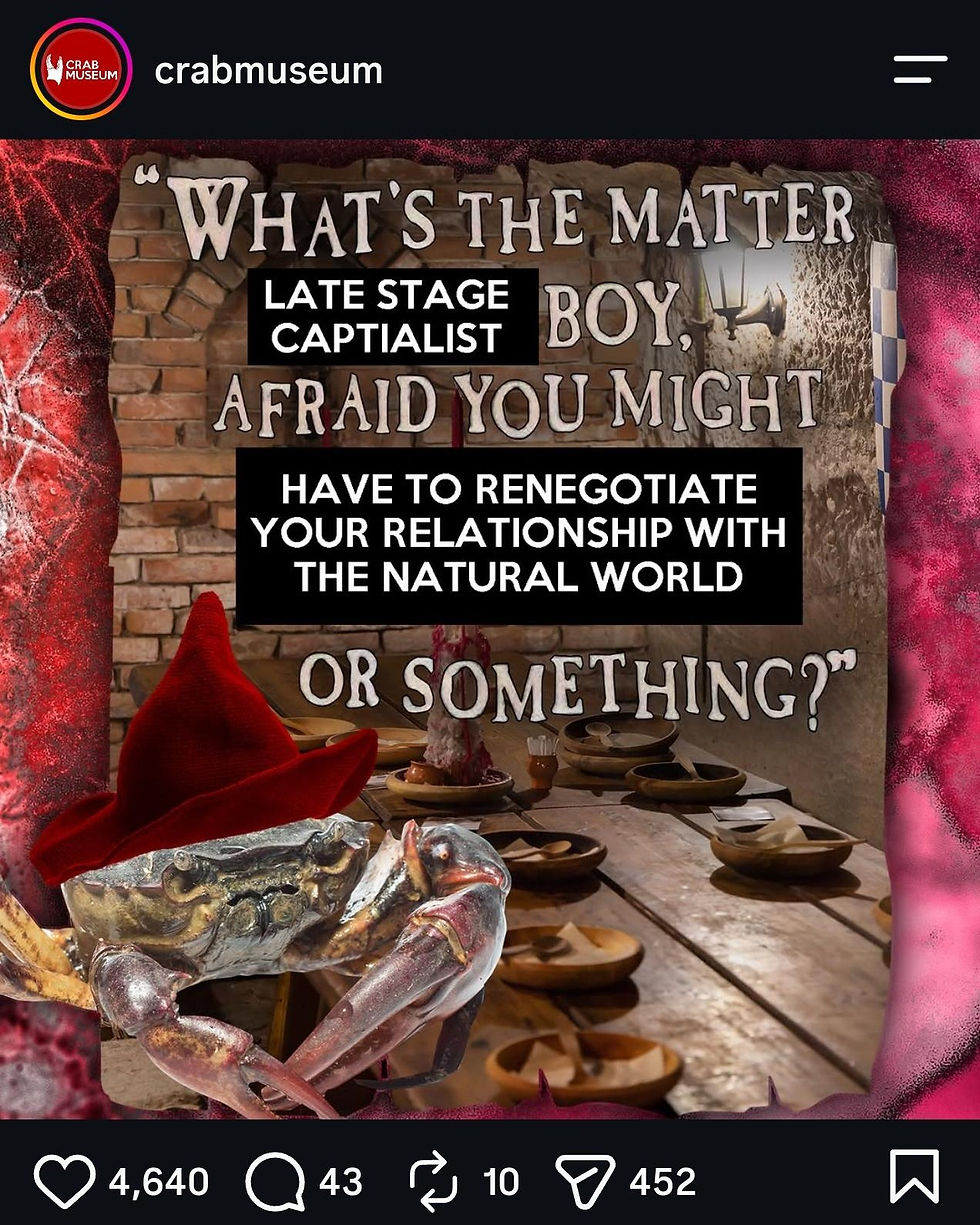
The second room thus subverts the conventional function of museums as places that share knowledge to places that share ideas and start conversations. In an interview with the Guardian, they say that “museums and the scientific community can’t really afford not to be activists any more.” In fact, the small Margate museum uses their popular Instagram page to call out other museums for their lack of activism as exemplified by the museum’s bold posts attacking the Science Museum in London whose ‘renewable energy gallery’ is sponsored by fossil fuel industries and arms manufacturers. Ultimately, the message of the Crab Museum is to get people to care about crabs and to turn this caring about into caring for.
A different way of collecting
Being in a museum solely about crabs reminded me of the 1968 article ‘How to Exhibit a Bullfrog’ by William Conway in which a devil transports the author to a zoo entirely devoted to every aspect of the bullfrog, a species the author first finds entirely unremarkable. I mention this because Rosa rightly asks us to consider zoos as living collections in which animals are curated just like museum objects are. This fictional zoo that Conway enticingly describes presents the frog’s evolution, their lifecycle, tanks and displays with their prey and those that predate them, the ecology of the ponds they inhabit throughout the seasons, and much more. “Could it be that any zoo in this day of diminishing wild creatures is more interested in swelling its census than expanding its effectiveness?”, the devil provocatively asks the author. Critical readers might ask what ‘effectiveness’ is supposed to mean here, but the article answers this towards the conclusion: “it is the Bronx bus driver and corner pharmacist whose votes will determine the fate of the Adirondack wilderness, the Everglades, of Yellowstone Park (…) you must give your visitors a (…) feeling of personal interest in diminishing wild creatures and collective responsibility for their future which is so closely linked to that of man”.
While Crab Museum might not be a zoo, they certainly follow a similar example in how they exhibit a crab and with a similar goal: To get people to care and to take action. Whether action looks like boycotting a museum with questionable ethics, reevaluating your relation to the natural world, or changing your consumption patterns, maybe it is time museums take up a more activist role.
Herre de Bondt is a postdoctoral researcher at the University of Amsterdam where he researches dogs and urban safety in Amsterdam. He completed his PhD in anthropology at Roehampton University in London which he dove into the world of bird feeding in gardens and public urban spaces. With a background in anthropology and urban studies, Herre conducted various multispecies research projects ranging from crows in Tokyo, to gulls in The Hague, and to rats in Amsterdam. Previously a fellow with the Animal Turn, Herre now volunteers as an assistant content producer for the show.
You can connect with Herre via Twitter (@HerreBondt).Learn more about our team here.


Comments