
Animal Gaze on-XR: An encounter between humans and nonhuman animals, arriving from different timelines to see our present as tomorrow’s history
Updated: Apr 28
Animal Gaze on-XR is a virtual speculative archive exhibition based on the original narrative of the physical exhibition of the same name (Animal Gaze) held in Istanbul (Türkiye) in 2023. It features multimedia artworks (some digitized from physical art, and others created digitally) by eleven participating artists from Türkiye, Canada, the US and Germany. This collaboration between the Animal Gaze Project (AGP) and on-XR follows the same background story and conceptual limitations that shaped the initial project.

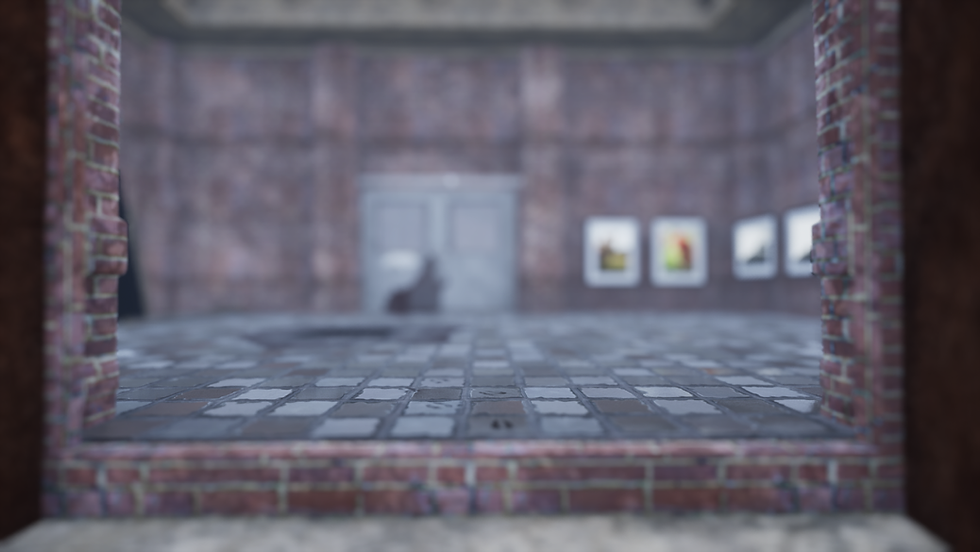
The exhibition imagines a future where nonhuman animals are no longer treated as “natural resources” at the service of human beings, whether for clothing, food, entertainment, or medicine. In this future, the history of animal exploitation has become a relic of the past. The setting of this exhibition is a former slaughterhouse repurposed as a permanent exhibition space; its goal is to curate an (an)archival record specifically for the animals of the future [1]. Meanwhile, the human audience of today participates indirectly in this encounter, looking at what these future animals have come to see and witnessing the history their ancestors endured. Each artist has contributed at least one piece intended to serve as a record for this future archive, creating an "exhibition within an exhibition."
This speculative encounter finds its inspiration in Jacques Derrida’s reflections in The Animal That Therefore I Am. In his famous encounter with a cat, Derrida recognizes that the animal looks at him as much as he looks at her, prompting a consideration of the "animal gaze"—an aspect largely ignored in the history of Western philosophy. The realization that animals possess an outward gaze—one we cannot fully know—prompts a crucial shift in thought: animals are no longer objects to be looked at, but subjects with their own gaze and a subjectively entangled Umwelt [2] This recognition is perhaps the most vital step toward the liberation of animals; it stands in direct contrast to the traditional treatment of living beings as a “heap” or a “flock,” defined only by their utility or categorized as “livestock.”
Within this context, Animal Gaze asks: What if animals looked at their own history of exploitation in a future where they were finally liberated? What would happen if we confronted these animals as they reflect on their own past, and what would it mean to look at ourselves through their eyes?
The interweaving of the present and the future through this shifting temporality raises urgent questions regarding the persistence of violence. Is this exploitation truly a thing of the past, or is it still occurring the moment we step out the exhibition space? Are we carrying animal parts on our bodies right now, or currently digesting them in our stomachs?
This is where all gazes, human and nonhuman, meet.
The "animal gaze" of this exhibition as well as the Animal Gaze Project (AGP) is a provocation. While the phrase typically suggests the perspective of the nonhuman other, we use it to problematize the human-animal dichotomy and the very act of looking. By challenging the traditional, human-centric vision that separates "us" from "them," we have created a space where human animals of today and the nonhuman animals of the future witness the same archival exhibition[3]. It is an invitation for us, humans of today, to imagine the weight of looking at an archive of one's own ancestors, a history of objectification and exploitation.
The spatial journey of the exhibition is a deliberate curatorial choice designed to foster a post-anthropocentric way of relating to fellow creatures, standing in direct opposition to human exceptionalism. In the first room, there are no artworks where an animal looks back at the visitor. This absence is an invitation to move beyond the traditionally humanist logic of the gaze[4]. While we have been looking at animals since our first encounter with them, the issue is not merely whether our eyes meet, but rather how we look.

Each artwork functions as an archival fragment, telling a story that asks us to reconsider what we have long taken for granted, assumed, and accepted. From here, a tunnel-like passage[5] leads us to the second room. It is only here that we finally meet the gazes of nonhuman animals. Because most of us are accustomed to "seeing" animals as objects or symbols, it requires a significant shift in perspective to "see" the individual "Other" who has their own way of living that is no less meaningful or valuable than our own.
Can we imaginatively step into their paws, hooves, or feet, and question which animals we recognize as individuals in contrast to those we categorize only as numbers or body parts? Can we try to feel with them as fellow creatures?
There is no way out of this second room. We cannot use the door, but we can look inside; it leads to where body parts were once kept, now empty. Where are we now? Are we the same people who entered through that door, or has something started to shift? That shift is the ultimate aim of this exhibition.
Ethical Responsibility & Accessibility
Because this is an exhibition designed for nonhuman animals, human language is avoided within the artworks and the space as a whole. In a commitment to ethical responsibility and respect, the archive avoids graphic imagery; it is a matter of dignity not to show a fellow creature the details of how their ancestors suffered (and were killed). Instead, the artists tried to imagine how an alternative, non-objectifying archive and artistic storytelling might work, and how a cow, a sheep, a pig or a turkey might be feeling as they endure this violent reality of today.
Finally, the curation accounts for varying physicalities, ensuring that the height and placement of works allow for diverse species to see and experience the art. Animal Gaze remains a place of encounter and witnessing—a site where the marginalized, objectified, and mythologized arrive from different dimensions of time to meet.
Practical Information:
To visit the exhibition, find it on Steam, install it for free, and click play.
Animal Gaze on-XR is currently only compatible with Windows PCs. As AGP, we’re planning to release an update in the last quarter of 2026 to expand compatibility to macOS as well.
Because the exhibition is meant to feel as realistic as possible, the graphics are high quality which requires a computer with a mid- to high-level graphics card.
Extracts taken from the exhibition catalogue available on: https://www.animalgazeproject.com/animal-gaze-on-xr/
Ece Nada
Curator, Visual Artist & PhD Candidate (Brock University)
[1] Hal Foster, “An Archival Impulse,” 2004.
[2] Directly translated from German as “environment,” biologist Uexküll's Umwelt refers not to an external container nor to an internal projection, but to a structurally meaningful world shaped by the organism’s embodied and affective capacities. (Jakob von Uexküll, A Foray into The Worlds of Animals and Humans: With a Theory of Meaning. Minneapolis: University of Minnesota Press, 2010.)
[3] Footprints on the floor allow today’s visitors to follow the path of the future animals as they move across the exhibition floor.
[4] See Anat Pick’s Creaturely Poetics (2011) where she argues that there is something transactional about our expectation for “the animal” to look back at us, and confirm our humanity. Do we need the animals to look back in order to care about them?
[5] This "tunnel" was designed based on the curved ramp model that Temple Grandin created, which is part of this archive. Because of the curve, animals moving toward the slaughter area cannot see what is coming, which simplifies the "operation."


I didn't expect the simple controls in Drive Mad to be this tricky. Keeping the car balanced over the ramps took me a few attempts.
Every floor in My Perfect Hotel makes my hotel bigger and better.
Every match in Ragdoll Hit feels like a brand-new comedy sketch 😆
I genuinely get excited each time I open Tiny fishing because I never quite know which rare fish might show up that session.