
S9E4: Segregation with Jules Skotnes-Brown
Jules Skotnes-Brown joins Claudia on the show to discuss how segregating logics were used to govern humans and animals in South Africa’s history. This includes everything from Addo’s elephants being driven, enclosed, and “tamed”, to Kalahari San people being policed inside a national park and managed through rations and confinement.
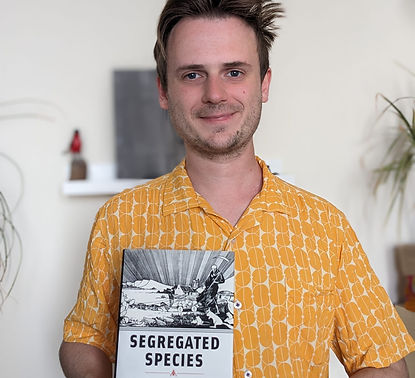

Jules Skotnes-Brown is a historian of animals, disease, and knowledge production in the nineteenth and twentieth centuries. He is the author of Segregated Species: Pests, Knowledge, and Boundaries in South Africa, 1910-1948, which won the Royal Historical Society’s First Book Prize in 2025. He is currently writing a second book on the global history of rats, plague, and capitalist infrastructure in the twentieth century. Jules completed his PhD at University of Cambridge History and Philosophy Science in 2020. Jules is a Wellcome Trust Research Fellow at University of Liverpool and PI of the Wellcome Trust funded research project 'Conserving Global Health: Biodiversity Protection and the Prehistory of Planetary Health' (2026-2031). The project will explore the historical engagements, collaborations and frictions between conservation theories and practices and international, global, and planetary health in the long twentieth century. In so doing, it will provide a prehistory of Planetary Health.
Mentioned:
Segregated Species: Pests, Knowledge, and Boundaries in South Africa,1910–1948 by Jules Skotnes-Brown
The Kruger National Park: A Social and Political History by Jane Carruthers
What Was It Like to Be a Cow? History and Animal Studies by Erica Fudge
The History of Animals in the Present Moment by Erica Fudge
Afro-Dog: Blackness and the Animal Question by Bénédicte Boisseron
Venus in Two Acts by Saidiya Hartman
Vermin Beings: On Pestiferous Animals and Human Game by Clapperton Chakanetsa Mavhunga
Necropolitics by Achille Mbembe
The Sanitation Syndrome by Maynard Swanson
Elephants in Africa by Frank Melland
The Global War Against the Rat and the Epistemic Emergence of Zoonosis
Scurrying seafarers: shipboard rats, plague, and the land/sea border by Jules Skotnes-Brown
Sulphuric Utopias: A History of Maritime Fumigation by Lukas Engelmann and Christos Lynetris
Stones: Animal Histories of Kingston by Claudia Hirtenfelder


“The elephant problem, a term which I use as one uses the unsatisfactory phrase ‘the native problem,’ because it means to me much the same thing – the rectification of our past mistakes and the attempt to bring an old, indigenous and very different form of life into harmony with our own life and aims” from Frank Melland, Elephants in Africa (1938: 145).

Thank you to Animals in Philosophy, Politics, Law and Ethics (A.P.P.L.E) for sponsoring this podcast; the Sonic Arts Studio and the Sonic Arts of Place Laboratory (SAPLab) for sponsoring this season; Gordon Clarke (Instagram: @_con_sol_) for the bed music, Jeremy John (Website) for the logo. This show is produced and hosted by Claudia Hirtenfelder.