
S9E1: Animals’ Cultural Histories with Sandra Swart
Claudia speaks with historian Sandra Swart about the importance of recognising animals’ cultural histories. They discuss the maturation of animal history as a field and focus on the cultural histories of baboons and elephants in South Africa.


Sandra Swart is Professor and Chair of the Department of History at Stellenbosch University, South Africa. She is Director of the African Anthropocenes Research Centre, Guest Professor of Anthropocene History at KTH Royal Institute of Technology, Sweden, and co-Vice President of European Society for Environmental History. She received her DPhil in Modern History from in 2001, and simultaneously an MSc in Environmental Change and Management, both at Oxford University. She studies the more-than-human history of southern Africa. She is an editor of the Brill book series African and Asian Anthropocene: Studies in the Environmental Humanities. She is the co-author with Greg Bankoff, of , Breeds of Empire: The ‘invention’ of the horse in the Philippines and Southern Africa, 1500-1950 (Nordic Institute of Asian Studies Press 2007); co-editor, with Lance van Sittert, of Canis Africanis: a dog history of southern Africa (Brill, 2008), co-editor of Gender and Animals in History (Amsterdam University Press, 2024), and co-editor with Emily O’Gorman, Mark Carey and William San Martín, The Routledge Handbook of Environmental History (Routledge, 2023). She is sole author of Riding High – Horses, Humans and History in South Africa (Johannesburg: Witwatersrand University Press, 2010) Her most recent book is The Lion’s Historian – Africa’s Animal Past (Ohio University Press, 2025), winner of the Southern African Historical Prize 2025. Learn more.
Mentioned:
The Lion’s Historian by Sandra Swart
Riding High: Horses, Humans, and History in South Africa by Sandra Swart
The Dreaded Comparison by Majorie Spiegel
Cooperative Hunting: How Eels and Grouper Partner on Prey

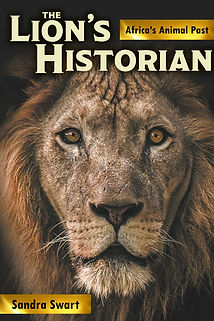
“We need to write histories taking a broader view beyond that of the hunter. We need accounts that connect deep history to the present moment. We need stories in which gender and generational context are not forgotten. These new histories will allow us to understand our own past as more complete in a multi-species and more-than-human context. But I would go much further and suggest that the other animals have their own histories too, both entangled in and independent of our human histories. Our understanding that animals have their own ‘cultures’, their ‘having history’ becomes irrefutable. What, after al, is history if not cultures changing over time?” - Sandra Swart, The Lion’s Historian (2023, 83).

Thank you to Animals in Philosophy, Politics, Law and Ethics (A.P.P.L.E) for sponsoring this podcast; the Sonic Arts Studio and the Sonic Arts of Place Laboratory (SAPLab) for sponsoring this season; Gordon Clarke (Instagram: @_con_sol_) for the bed music, Jeremy John (Website) for the logo. This show is produced and hosted by Claudia Hirtenfelder.